

Disclaimer: I am not an attorney, and the content of this article is for informational purposes only. It should not be construed as legal advice. If you have specific legal questions or concerns, please consult with a licensed attorney in Kansas.
In the vast expanse of Kansas, with its rolling plains and sprawling fields of wheat that seem to touch the horizon, there’s a less idyllic sight: stray dogs in Kansas. It’s an unlikely challenge the Sunflower State faces in both rural and urban settings. You’re as likely to encounter a stray dog roaming the outskirts of a city like Wichita as you are the the quiet streets of Abilene. The impulse to rescue these dogs can be strong. But navigating the laws regarding adopting a stray dog in Kansas requires an understanding of the state’s approach to animal welfare. What do you need to do if you find a stray dog? And how long before a stray dog is legally yours in Kansas?

How Long Before A Stray Dog Is Legally Yours In Kansas?
Stray dogs in Kansas that are surrendered to animal control or animal shelters must be held for a minimum of 3 days before they can be legally adopted. This holding period gives owners a chance to reunite with their dogs before those dogs have the opportunity to find new homes.
These rules are outlined in Kansas Statute K.S.A. 47-1710. During this mandatory hold period, facility operators must make reasonable efforts to identify and notify the owners of the impounded dog.
After the three-day custody period, the pound or licensed animal shelter becomes the owner of the dog. They have the authority to determine what happens to the dog after the 3 day holding period mandated by the state.
Notably, the law directs that all proceeds from the adoption or other disposition of the animals go to the treasury of the municipalities where the adoption or disposition occurs. The process does not allow any individual to profit.
Kansas Statute K.S.A. 47-1710 ensures a balance between the opportunity to reunite lost pets with their owners and the chance for these animals to start anew with loving families. This emphasizes the state’s commitment to animal welfare. This process highlights the importance of legal adherence and ethical consideration in the welfare of stray animals.
The Best Collar For Rescue Dogs
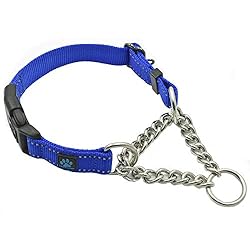
This is the Martingale I use for my own dogs and for rescue dogs, and I can’t recommend it highly enough. For every collar they sell, Max and Neo donate a collar to an animal rescue organization. I know the donation box at my shelter is typically full of them. It comes in either a chain or nylon loop. Features like a locking clasp, reflective nylon stitching, and a separate tag loop for noise reduction make it stand out. Again, I highly recommend this collar.